Last month, I had the privilege of leading a group of 5 students and 4 adults on an educational trip to Peru, South America. This is my fifth trip with travel company, EF Tours. They do a phenomenal job of dealing with the minutia of coordinating the itinerary, booking local guides and transportation, finding restaurants, hotels, etc., so all I have to do is wrangle my own group. Which isn’t a chore at all considering the adults are all seasoned travelers and the students are some of the brightest I have.
I can’t begin to provide all the details of this 11-day trip, but I’ll do my best to capture the highlights. If you’d like more photos and videos, check out my Instagram feed as I’ll be adding images and reels there with an expanded view of the sites and tastes of Perú.
We traveled from Indianapolis to Atlanta, then on to Lima. Talk about a city with crazy drivers! In Lima, population ~12 million, lanes seemed optional, as were turn signals, stop signs, and yields. The only signals that seemed to matter were stop lights and horns. There is an entire language in horns, so before you attempt driving in Perú, consider leaning not only Spanish, but horn.
From Lima with views of vast swells of the Pacific Ocean and historic colonial Spanish-style buildings, we flew to Cusco at an elevation of ~12,000 feet above sea level. Dizziness hit me the minute we stepped off the plane. A few seconds of deep breathing helped and I was able to navigate through the airport and onto the bus waiting for my group of 10 and our traveling companions, a group of 16 from British Columbia, Canada.
Photos left to right, top to bottom: view of countryside, Koricancha Temple courtyard, weavers at work, group at the ocean in Lima, Incan stonework inside excavated Koricancha temple, Cusco from Sacsayhuaman, Cusco from Korikancha showing Inca symbols in terraced area – Condor, Puma, Snake; Lima government buildings, whole group in Lima, artifact from Larco Museum in Lima, Pacific Ocean from Lima, Governor’s residence in Lima

We visited the Koricancha Sun Temple, an Incan relic destroyed by the Spanish soon after their conquering of the Incan people. The intricate fit of the huge blocks, the beveled edges and earthquake-proof no mortar construction is a marvel of architecture. We tried alpaca for lunch––like lean beef or venison.
After a stop to purchase alpaca wool sweaters, we headed down the mountain loop toward Urubamba. The views from our hotel of the surrounding mountains was surreal. In the morning, the shrouding mist steeped the peaks in mystery. The turbulent power of the Urubamba River that snakes through the region is another reminder of the connection between man and nature––one the Inca cherished.
The next day we traveled to Ollantaytambo, learning about the hundreds of varieties of corn and potatoes grown in the region. Also, quinoa, squash, barley and other produce. The fields are mostly prepared using oxen and single-bottom ploughs or disc ploughs. The town is a relic from the past and contains an unfinished Sun Temple. We learned how the Inca worked in community to move the multi-ton blocks brought from miles away to construct the temple. We also learned about the aqueduct for water and food preserving buildings constructed on the facing mountain.
At a textile cooperative we were immersed into the ins and outs of dying, preparing, spinning, and weaving alpaca and sheep wool to make the beautiful capes, blankets, runners, and other products with Incan and other native designs. We ended the day at the Maras Salt ponds which produce pink salt as found in the Himalayas. This stop could have been skipped as the ponds were interesting, but not worth the long drive.
One of the most anticipated parts of the journey occurred the next day as we took the train to Aguascalientes (aka Machu Picchu Town) to await our turn on the bus up the switchbacks to Machu Picchu. The scenery along the tracks included lovely views of the turbulent Urubamba River, sightings of the famed Inca Trail along with hikers and Sherpas carrying huge loads.
Photos left to right, top to bottom: structures at Machu Picchu, our entire group during a weaving demonstration, a group of alpacas at Ollantaytambo, Wayna Picchu mountain, stone steps at Sacsayhuaman, a student trying a Yaguas dart gun, Yaguas village girl, students in front of Machu Picchu, stairs at MP, hubby and I in doorway at Sacsayhuaman, whole group @MP, teething llama at MP, hubby and I at MP, night view of Cusco, Urubamba River and Machu Picchu train from Aguascalientes, view from inside the train.

A delay caused by a rock slide put us on a tight schedule and we grabbed empanadas to eat on the way. I love empanadas and these were among the best I’ve ever eaten. The long climb up to the Incan site was worth the short breath and stinging muscles. Our first view rivaled any online photo I’ve seen. The mysterious rock structure set amongst a green carpet amid a panorama of mountains and valleys lived up to its hype.
Surrounded by an air of power and mystery, the site pushed me to consider the Incans and their gods as compared to my own. With Machu Picchu mountain’s puma-shaped topline and the deep vee called the Sun Gate that allows access on the solstices, it wasn’t hard to imagine the native people’s beliefs. But how does that reconcile with my own worship of Jesus, the Creator, a member of the triune God of the Bible?
The Incan solar alignments weren’t random. Their knowledge was granted from somewhere, by someone. I can’t believe my God who claims to be love itself would let these people perish without the chance to save themselves. Somehow, someway, they had access to Him.
The next day was Palm Sunday and we caught a procession of school-aged children with palm branches and white robes. Catholicism may have been forced on the native people, but it took hold and is alive and well, today. As with any country, many have rejected the practicing of their faith, but not the name.
The Pisac market held many delights and we tried cuy (Guinea pig) – a Peruvian and Ecuadorian delicacy. Also, I recommend lomo saltado – beef loin as a steak or made into a type of stir fry. Saqsaywaman was another Incan fortress temple near Cusco. We navigated a cave maze near the water mirror used by priests to track the movement of celestial bodies and create the very accurate calendar.
Our final adventure was a trip to Iquitos – one of the largest cities in Peru and only accessible by plane or boat. From there we took a ferry up the Amazon to Amak lodge. The lodge had solar powered light but only generator electricity 3 x per day. There was a round reception area, a dining room, and many lodges spread out in the jungle.
Below, in more or less clockwise order: my students climbing in the lianas, a sunset view on the Amazon, our cabin tarantula and the cabin below, the Amazon from the plane, clouds over the Amazon at sunset, Amazon sunrise, my husband on our jungle walk, an adult traveler with his red piranha, my students in the covered boat, the butressed trunk of a kapok or ficas tree. (I can’t remember which this is.)
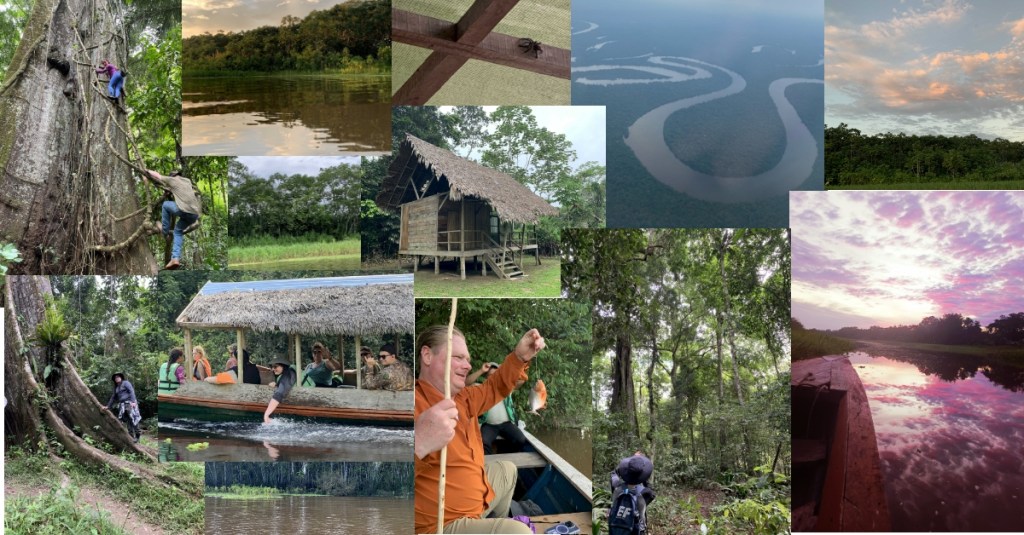
Our lodge had a pre-installed tarantula and later a large tree frog joined us in the shower – a cold water shower. The beds had mosquito netting, but with our spider, we saw no mosquitos during the night.
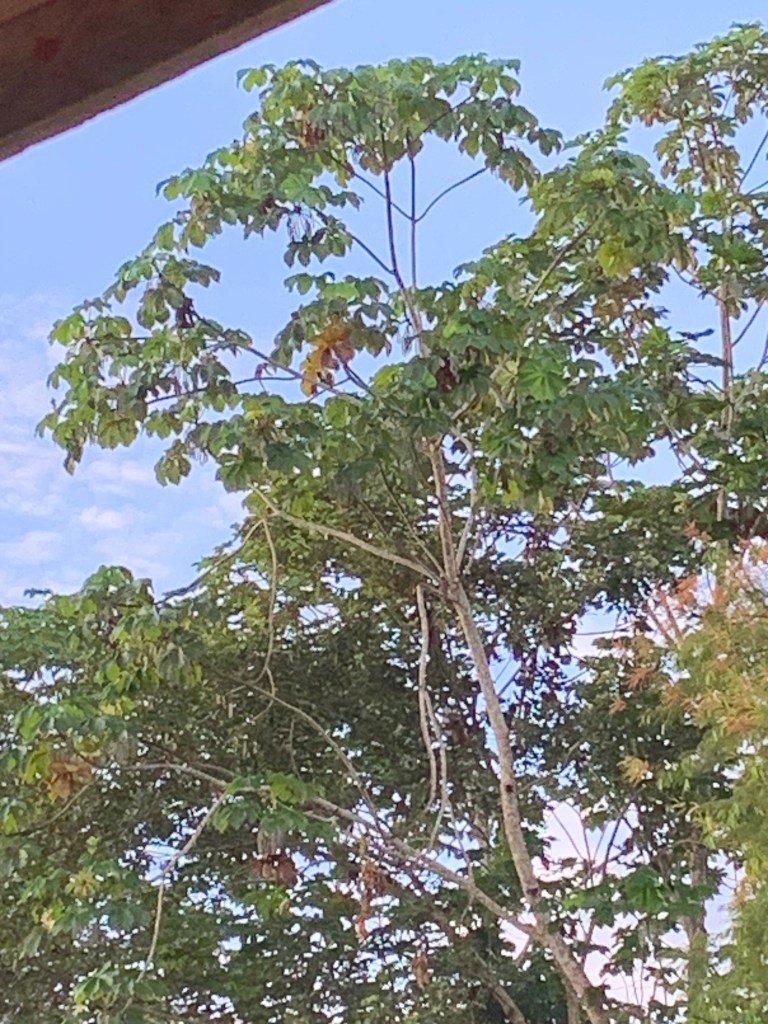
I can’t stress enough the relaxing atmosphere of the lodge. The trips out in the open topped boats to see birds, pink river dolphins (we did see several), fish for piranha, visit a local tribe called the Yaguas, and enjoy the water and the jungle sights were filled with joy. Even the humidity, broken by the breeze on the water, couldn’t spoil the moments. We hiked through the jungle to see kapok trees and other native species. Climbed the lianas vines and searched for wildlife. The next day some of us saw a troop of squirrel monkeys. The monkeys are the darker brown shapes in the tree top below.
I enjoyed everything about this adventure. If you’ve considered traveling to Perú, you should. It was worth visiting.
Have you ever traveled to South America? If so, where? Where is your favorite place to visit?
Which photo is your favorite? I have many favorites – so many, I’d be hard-pressed to choose. Each time I travel, I learn more about the world and the people. Culture is an interesting thing that is constantly changing. I try to absorb as much as possible to share with those at home who aren’t able to hop on planes, trains, and busses to explore.
Thanks for reading! Consider subscribing to my monthly newsletter for encouragement, a glimpse into my worlds, and subscriber giveaways. If you enjoy Montana, rodeos, or characters searching for a place to belong, you might enjoy my debut novel coming May 16th as part of a 4 novel summer romance anthology called Bright Lights. See my website for details and as always you’re in my thoughts and prayers. I appreciate your support and attention. Vaya con Dios!
 Rebecca Reed, Author
Ooooh! I would LOVE to go. I have some former students in Guatemala, so if I ever get the chance, that’s probably my destination. Still… so beautiful. Thanks for sharing!
LikeLiked by 1 person
I will always recommend travel – to anywhere, at anytime. Travel opens places within me that mightn’t have ever been discovered otherwise. Central America is lovely. I haven’t been to Guatemala, but I’ve been near there in the Yucatan of Mexico. Meeting locals and soaking in the geography, food, and culture of a new place are some of my favorite pastimes.
LikeLike